
Read the first part of the article at the following link: https://jnews.az/yeruselim-problemi-tarix-din-ve-kimlik/
After David’s death, his son Solomon ascended to the throne. During Solomon’s reign, Israel experienced unprecedented prosperity and wealth. Both the Torah and the Quran provide extensive information about Solomon.
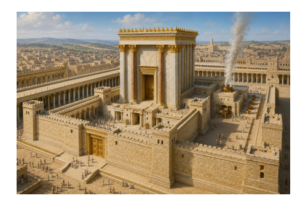
Solomon fulfilled the divine promise given to his father and, by God’s command, had the Temple built in Jerusalem. This Temple subsequently became the center of Jewish religious life in later centuries and further strengthened Jerusalem’s status as a sacred city. Construction of Solomon’s Temple began around 967 BCE. The construction involved craftsmen from the tribe of Naphtali and master builders sent by Hiram, the ruler of the city of Tyre. The construction lasted many years and resulted in one of the most magnificent religious structures of the era.
The sacred texts provide extensive information about Solomon’s wealth, power, and wisdom. The Quran describes the visit of the Queen of Sheba to Solomon’s palace:
She was told, «Enter the palace.» When she saw it, she thought it was a vast expanse of water and felt afraid. Solomon said, «This is a palace of crystal.» She said, «My Lord, I have wronged myself. I submit with Solomon to God, the Lord of all worlds.» (Quran 27:44)
This verse speaks of the great blessings and privileges given to Solomon and his people under his rule.
After the Temple was completed, Solomon prayed to God. His prayer is recorded in the sacred texts:
But will God really dwell on earth? The heavens, even the highest heaven, cannot contain you. How much less this temple I have built! Yet give attention to your servant’s prayer and his plea for mercy, Lord my God. Hear the cry and the prayer that your servant is praying in your presence this day. May your eyes be open toward this temple day and night, this place of which you said, ‘My Name shall be there,’ so that you will hear the prayer your servant prays toward this place. Hear the supplication of your servant and of your people Israel when they pray toward this place. (1 Kings 8:27–30)
Solomon was distinguished by his wisdom and justice. According to religious tradition, God granted him wisdom that was not given to other rulers, and he governed the people of Israel with justice.
However, after Solomon’s death, the kingdom of Israel that David had founded and Solomon had strengthened was divided. Around 937 BCE, during the reign of Solomon’s son Rehoboam, the state split into two parts. In the north, the kingdom of Israel encompassed ten tribes, while in the south, the kingdom of Judah was formed by the union of the tribes of Judah and Benjamin. Jerusalem remained the capital of the kingdom of Judah.
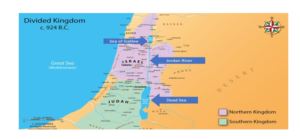
One of the main reasons for this division was Rehoboam’s inability to continue his father’s policies and maintain unity among the Israelite tribes.
In 722 BCE, the Assyrian Empire conquered the northern kingdom of Israel. A large portion of the Israelite people was exiled to Assyria, and other peoples were settled in their place. This event is considered one of the first major exiles in Jewish history and laid the foundation for the formation of the diaspora.
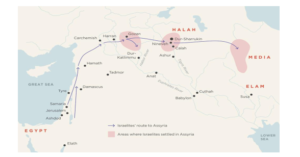
However, the southern kingdom of Judah was able to maintain its independence for a time. Jerusalem preserved its glory and religious significance. But approximately a century and a half after the fall of the kingdom of Israel, in 586 BCE, the Babylonian ruler Nebuchadnezzar attacked Judah. Jerusalem was conquered, Solomon’s Temple was destroyed, and the city was burned. Many Judeans were killed, and the majority of the survivors were exiled to Babylon.
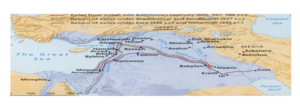
Thus, the Jews were separated from their sacred cities and ancestral lands. It was during this period that legends emerged about the loss of the Ark of the Covenant, and its subsequent fate remained unknown.
Approximately fifty years later, the Babylonian Empire was conquered by the Persians. The Jews living in exile witnessed with their own eyes the fall of the Babylonian state that had destroyed their sacred cities.
In 538 BCE, the Persian ruler Cyrus II permitted the Jews to return to Jerusalem and their ancestral lands. He also permitted the reconstruction of the destroyed Temple. This event is considered one of the turning points in Jewish history.
The construction of the Second Temple lasted a long time and was completed in 516 BCE during the reign of Darius II. Although the new Temple was not as magnificent as the first, the Jews again began to worship God there, and Jerusalem once again became the center of their religious life.
In 332 BCE, Alexander of Macedon defeated the Persian Empire, and as a result, the Jews came under Greek rule. According to Jewish tradition, when Alexander came to Jerusalem, he met with the High Priest Simon the Just, and after this meeting, he decided not to harm the Temple. During Alexander’s rule, the Jews and Jerusalem lived in relative peace.
However, after Alexander’s death, his empire was divided. Jerusalem initially came under the influence of various Hellenistic rulers and later came under the control of the Seleucid Empire. During this period, the Seleucid ruler Antiochus IV Epiphanes attempted to Hellenize the Jews, forcing them to adopt Greek culture and religious traditions.
At that time, the Jews were one of the only monotheistic peoples in the ancient world. According to their belief, the entire universe was created by an invisible, eternal, and merciful God. This worldview differed fundamentally from the polytheistic Greek religious traditions.
Antiochus, aiming to weaken the religious identity of the Jews, first attacked the fundamental pillars of their religious life. He prohibited the observance of the Sabbath, the celebration of new moon festivals, religious holidays, adherence to kosher laws, and the study of the Torah. Torah scrolls were burned, sacred places were desecrated, and Jews were forced to renounce their faith.
Finally, circumcision was also prohibited. However, circumcision was considered the physical sign of the covenant between God and the Jewish people. Antiochus’s policy created serious resistance among the Jews, but the ruler resorted to ruthless methods to achieve his goals.
Jewish historian Rabbi Berel Wein describes this period in his work «Echoes of Glory»:
«Women who circumcised their sons were executed with their infants hung around their necks. Jews who refused to eat pork and make sacrifices to idols were subjected to deadly torture. In every city, altars were erected for Zeus and other Greek gods, and Jews were forced to participate in these ceremonies. God’s Temple was converted into a temple dedicated to Zeus Olympius.»
These events represented an unprecedented wave of religious persecution in the history of the ancient world. Until that time, in the polytheistic world, respect for the gods of different peoples was customary. The existence of different religions in polytheistic societies generally did not create problems. People could respect both their own gods and the gods of other peoples.
The Jews, however, took a different position. They worshipped only one God and considered obedience to His laws paramount. For this reason, many Jews were willing to endure suffering and even death rather than abandon their faith.
This period in Jewish history is remembered not only as a political struggle but also as an important struggle for the preservation of religious identity. The Jews believed that there are values in life that must be held higher than life itself, and the covenant with God was the most important of these values.
According to the ideology of the Torah, these prohibitions could lead to the gradual disappearance of Judaism and the Jewish people. As a result of all this oppression, the Jews rose up against the Greeks. Under the leadership of the Hasmonean family (also known as the Maccabees), the Jews launched a revolt.
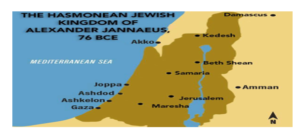
As a result of this uprising, an independent Jewish state existed from 165 BCE to 63 BCE—the Hasmonean dynasty. Today, the Jewish people commemorate this victory as Hanukkah.
However, over time, the Hasmonean dynasty weakened as a result of a civil war between two brothers, Hyrcanus and Aristobulus. Due to internal conflicts, the sides sought help from Rome. As a result, in 63 BCE, Roman forces under the leadership of Pompey entered Judea.
After Pompey conquered Jerusalem and killed many Jews, he appointed the weaker of the two brothers, Hyrcanus, as the nominal ruler of the region. Thus, the independent Jewish state effectively ceased to exist and came under Roman rule. Judea gradually became the Roman province of Judaea.
During Roman rule, a new religious movement emerged in Judea. Although Jesus was Jewish, he was not accepted as the Messiah by most Jews of the time. However, in later centuries, his teachings spread throughout the Roman Empire and Christianity became one of the world’s largest religions.
Jesus was crucified by the Romans in Jerusalem. During Roman rule, relations between the Jews and the empire became increasingly tense. The Jews sought to preserve their religious and national identity, while Rome sought to strengthen its control over the region.
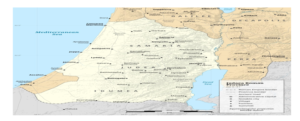
Finally, in 66 CE, the Jews launched a major uprising against Roman rule. In the initial phase of the uprising, they managed to cleanse Jerusalem of Roman forces. This Jewish success caused great shock in the Roman Empire.
(Part II), to be continued…
Murad Salmanov