
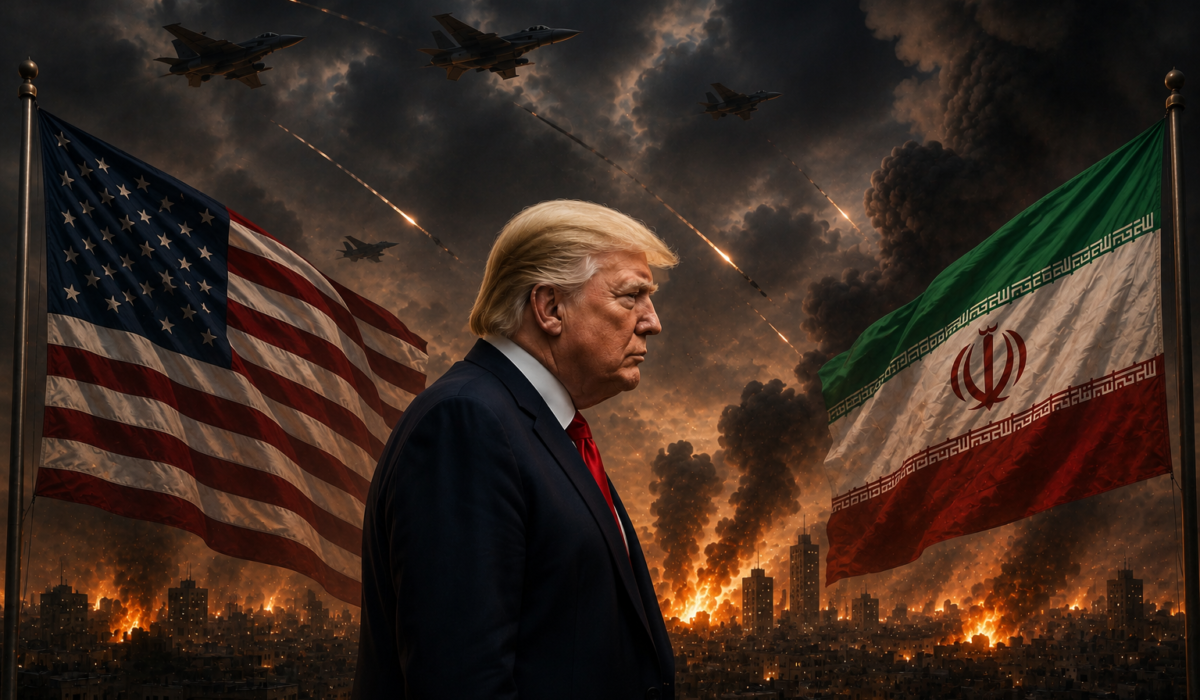
The US military announced on Wednesday morning that it has completed the 11th night of strikes against Iran.
The US Central Command (CENTCOM) reported that targets included military aircraft hangars and facilities housing unmanned aerial vehicles. The latest strikes were carried out after US President Donald Trump signaled that the attacks would intensify further.
Iran's Minister of Interior, Eskandar Momeni, traveled to Pakistan, one of the key mediators in the conflict, in an attempt to revive diplomatic efforts. However, it remains unclear what a new agreement to end the war, which has recently turned into a struggle for control over the Strait of Hormuz—vital for global energy supplies—would look like.
During a speech at the White House on Wednesday evening, Trump expressed skepticism about possible talks, stating that the US has "no interest in holding meetings." He also hinted that US forces could soon target an area near one of Iran's main uranium enrichment facilities.
Against the backdrop of stalled talks and the large-scale paralysis of shipping in the Strait of Hormuz, both sides are attempting to gain an advantage by targeting civilian infrastructure used by millions of people.
The consecutive US airstrikes have failed to weaken Iran's control over the Strait of Hormuz. Before the war, approximately one-fifth of global crude oil and natural gas shipments passed through this strait.
The US continued its airstrikes on Wednesday. Near Tehran, Iran's air defense systems were activated. Iran's state news agency, IRNA, reported that explosions occurred in the provinces of Bushehr, East Azerbaijan, Hamadan, Hormozgan, Khuzestan, and Sistan and Baluchestan.
Previously, on Wednesday evening, Iran targeted a tanker in the Strait of Hormuz, forcing the crew to abandon the ship. Iran has also continued its attacks against US allies in the region. According to reports, Iran has carried out attacks on Bahrain, Jordan, and Kuwait as well.
Rising tensions have caused energy prices to climb. On Wednesday, the price of Brent crude oil on the global market exceeded $92 per barrel, while the average price of regular gasoline in the US rose to $4 per gallon.
Iran-backed Houthis open new front in the Red Sea
In Yemen, the Iran-backed Houthi group has opened a new front in the Red Sea, announcing a naval blockade against Saudi Arabia. This move has created new risks for global oil supplies and trade. Since the Strait of Hormuz is closed, Saudi Arabia relies on a pipeline extending to the Red Sea to bring millions of barrels of oil to markets.
Yemen's SABA agency, which is under Houthi control, reported that on Wednesday evening, six ships sailing in the Red Sea were forced to change their routes following warnings from the rebels.
Three Houthi officials, who spoke on condition of anonymity, stated that the group advised international shipping companies on Monday not to pass through the Bab el-Mandeb Strait.
Trump: US has no interest in meeting with Iran
Iran's Minister of Interior, Eskandar Momeni, met with the Chief of Army Staff of the Pakistan Armed Forces, General Asim Munir. Later, he also held talks with Pakistan's Prime Minister Shehbaz Sharif.
In a statement, Sharif expressed serious concern over the US-Iran tension and called on all parties to exercise restraint and refrain from steps that would further escalate the situation in the region.
The Pakistani leadership and Asim Munir played a crucial mediating role in reaching a temporary agreement between the US and Iran last month. Islamabad is attempting to bring the parties back to the negotiating table.
Trump told reporters that Iranian officials "want the meeting to happen very much. But we have no interest in meeting until they are seriously prepared for talks." He added that the US could soon target a fortified underground complex near one of Iran's main nuclear facilities, known as Pickaxe Mountain.
Iran's military leadership stated in a statement released by state media that any attack on nuclear or other sensitive facilities would be considered a serious escalation.
Deep distrust remains between the parties. According to the article, Iran was subjected to unexpected attacks during the periods when it was conducting nuclear talks with the US in June 2025 and later in February. The temporary agreement was broken after Iran resumed attacks on ships in the Strait of Hormuz.
US strikes continue amid attacks on ships
The UK's "United Kingdom Maritime Trade Operations" (UKMTO) center reported that a tanker was attacked in the Strait of Hormuz off the coast of Oman on Wednesday evening, and the crew abandoned the ship.
Iran's Islamic Revolutionary Guard Corps has claimed responsibility for this attack, as well as for the targeting of two other ships in the same region on Monday.
The US military had previously advised ships to use routes near the coast of Oman to avoid Iranian control.
According to information released by CENTCOM on the X platform, US forces had redirected eight commercial vessels and rendered one ship inoperable by Wednesday evening to prevent a blockade in the strait.