
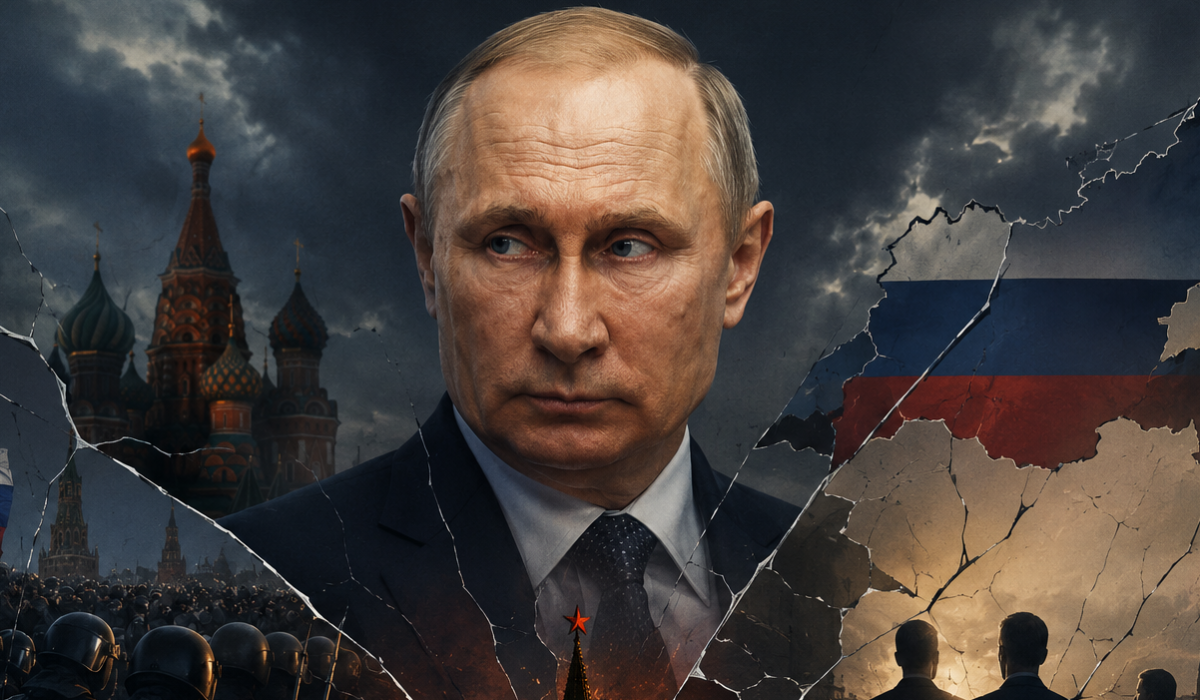
Discussions regarding internal political stability and the future of power in Russia have resurfaced. President Vladimir Putin's rule may face serious challenges in the coming years, and various political scenarios within the country are not ruled out.
An analysis published in Forbes states that despite Russia's existing security system, including the extensive capabilities of its special services and power structures, competition among the internal elite for resources and influence could increase political tension in the future. According to analysts, in such circumstances, there is a possibility of deepening disagreements within the government.
The article also draws attention to Russia's history over the last century. It notes that failures after the First World War and the Afghan War resulted in significant political changes in the country. The authors believe that the long-term consequences of the war in Ukraine could also accelerate similar processes.
Forbes writes that there is a tradition in Russian society of primarily attributing responsibility for problems to the state apparatus and high-ranking officials. This could lead to a weakening of mutual trust within the ruling elite and various groups attempting to protect their positions amidst potential political changes.
The analysis emphasizes that Russia's main power structures – the FSB, Rosgvardia, and other security agencies – have been competing for influence in various directions for many years. According to analysts, the position of these agencies could be one of the decisive factors in a potential power change scenario.
The article also puts forward various possibilities regarding a change of power. One is a rapid political change, while another is a scenario where governance is maintained by shifting responsibility from the current government to individual figures. The analysis compares this approach to historical analogies, citing events following the overthrow of Nicolae Ceaușescu in Romania as an example.
Forbes notes that some recent events in Kremlin political circles have also drawn attention. In particular, it recalls that Sergey Ivanov, who died on June 26 at the age of 73, was considered one of Putin's close associates and a possible political successor for many years. According to the publication, such events intensify discussions about uncertainty within the government.
The analysis also states that factors that could increase potential internal tension in Russia include drone attacks, economic problems, changes in the military situation around Crimea, and protest actions in the regions.
The authors also consider China's position a crucial factor. In their opinion, if Beijing believes that political stability in Russia is not in line with its strategic interests, it may try to use its economic and political influence.
It should be noted that the views expressed in the article are based on analytical assessments published in Forbes and are predictive in nature regarding the future development of events. Currently, there is no official information confirming that these scenarios will materialize.