
Read the first part of the article at this link: https://jnews.az/en/the-jerusalem-question-history-religion-and-identity/
Read the second part of the article at this link: https://jnews.az/en/jerusalem-problem-history-religion-identity-part-2/
Read the third part of the article at this link: https://jnews.az/en/jerusalem-problem-history-religion-identity-part-ii/
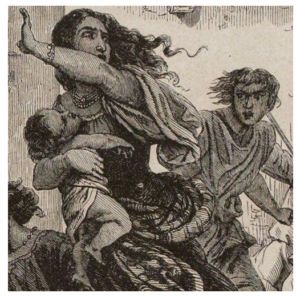
Muslim historian Ibn al-Qalanisi describes those events as follows:
“The helpless Jews took refuge in a synagogue. The Crusaders set fire to the synagogue, and the people inside perished along with it.”
These events are considered one of the most tragic pages in the history of Jerusalem. Sources note that the number of Jews and Muslims who died in the city was so high that it became difficult to move in the streets.
Jerusalem remained under Crusader rule until 1187. In that year, Saladin Ayyubi recaptured the city from the Crusaders, and it returned to Muslim rule. After Saladin’s death, although the Crusaders were able to regain control over Jerusalem for a short time, the Khwarazmians recaptured the city in 1244.
In 1260, Jerusalem fell under the rule of the Mamluk state. Later, in 1517, the Ottoman Empire defeated the Mamluks and incorporated the city into its territory. Thus, Jerusalem remained under Ottoman rule for approximately four centuries.
During the Ottoman period, Jerusalem and the surrounding region lived in relative stability and peace. Ottoman rule allowed Jews to settle in the city and own property. There is also an interesting legend associated with this period.
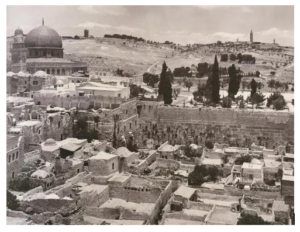
According to the legend, after Yavuz Sultan Selim conquered Jerusalem, he encountered an elderly Christian woman carrying a large basket on her head while walking through the city. When the Sultan asked what was in the basket, the woman replied that it was animal dung and garbage. The woman also said that she had come from Bethlehem, and after traveling for two days, she would dump this waste where the Jews’ holy temple was located, adding that this was ordered by Christian clergy. She stated that for centuries, animal dung and garbage had been dumped there every 30 days, with the intention of completely erasing the traces of the Jewish temple and wiping it from history.
The Sultan conducted an investigation and realized that what the woman said was true. He then gave an order, and bags filled with gold and silver coins were prepared and buried in various parts of the garbage pile. Saying, “Whoever finds gold can keep it,” shovels and containers were distributed to the poor, ensuring the cleaning of the garbage pile.
The Sultan himself even took a shovel in his hand to clear the hardened debris and had a decree read out:
“Whoever loves the Sultan and wants to please him, look at what I have done and do as I do.”
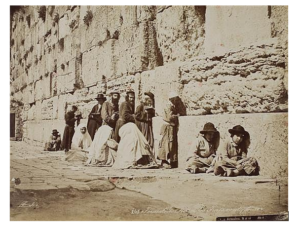
As a result, more than ten thousand people worked non-stop for thirty days to completely clear that large pile of garbage, and the “Kotel Ha-Maarav” (Western Wall of the Beit HaMikdash) was revealed in its current state. Seeing this, Yavuz Sultan Selim was very pleased and ordered that the old site of the temple be thoroughly cleaned and the wall washed with rose water.
This story is recounted in various forms in historical sources and is presented as a symbol of the care the Ottoman administration showed for holy sites in Jerusalem.
During the Ottoman period, Jerusalem continued to function as an important religious and cultural center where representatives of various religions lived.
In 1831, Ibrahim Pasha, the son of the Egyptian governor Muhammad Ali Pasha, captured the region, and Jerusalem remained under Egyptian rule for a time. However, in 1840, with the support of European states, the Ottoman Empire regained control over the region.
Thus, Jerusalem continued to remain under Ottoman rule until the end of the 19th century and played an important role in the formation of the city’s modern history.
In 1844, the city’s population was recorded: 7,120 Jews, 5,760 Muslims, and 3,390 Christians. From the 19th century onwards, Jews constituted the vast majority of Jerusalem’s population. The city was constantly expanding, developing, and becoming more beautiful.
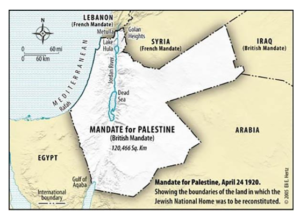
Defeated in World War I, the Ottoman Empire handed over the city and the region to the British. After the British captured Jerusalem and the surrounding territories in 1917, they created the Palestine Mandate, and Jerusalem became the capital of that mandate. (The name Palestine, as we noted above, was given by the Romans and later reused by the British. In fact, there was no separate nation called Palestine; the region was mainly inhabited by Jews and Arabs.)
Despite a difficult and turbulent history, Jerusalem continued its development. In 1918, the Hebrew University was founded there. The first lecture was delivered by Albert Einstein in 1923.
During this period, Jews living in exile were gradually returning to Jerusalem and the ancient lands of Israel. The increase in the Jewish population caused dissatisfaction among the Arab population living in the region. As a result, the conflict between Jews and Arabs was deepening. The British administration had difficulty preventing the incidents.
As attacks by Arab armed groups on Jewish settlements increased, the Jews created the Haganah (Defense) organization to defend themselves. This organization later formed the basis of the Israel Defense Forces.
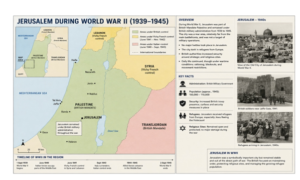
Between 1939 and 1945, under the leadership of Adolf Hitler, an unprecedented genocide was carried out against the Jews. Six million innocent people were brutally murdered simply because they were Jewish. Thousands of Jews who survived the genocide wanted to move to Jerusalem and the ancient lands of Israel. However, the British administration strictly restricted this migration.
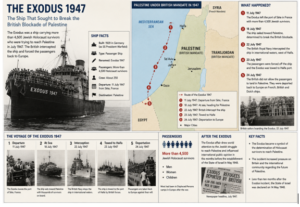
Even Jewish refugees on the “Exodus” ship, who wanted to come to the lands of Palestine while fleeing Hitler’s persecution, were turned back. This incident caused serious dissatisfaction in the world community and was assessed as a major humanitarian tragedy.
The Jewish-Arab conflict was intensifying, and the British were beginning to lose control of the situation. As a result, Great Britain referred the matter to the United Nations. In 1947, the UN adopted a resolution on the creation of two states in the region – one Jewish and one Arab state.
On May 14, 1948, the creation of the State of Israel was announced, and the task of forming the government was entrusted to David Ben-Gurion. However, the Arab states did not accept this decision.
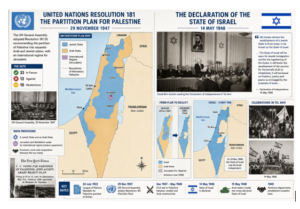
Before the war began, a portion of the Arab population living in the region began to migrate. The first migrants were mainly wealthy families. With the start of the war, hundreds of thousands of Arabs left the region.
At the same time, Jews living in Arab countries also faced pressure, their properties were confiscated, and in many cases, they were forced to leave their countries. Approximately 820,000 Jews left Arab countries, and nearly 526,000 of them moved to Israel.
(Part IV), to be continued…
Murad Salmanov