
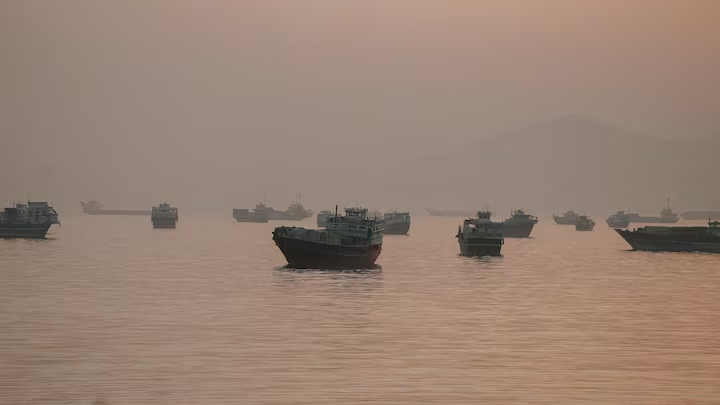
As mediators discuss draft agreements between Tehran and Washington, the contours of a possible deal regarding the Strait of Hormuz are becoming clearer. However, it remains uncertain when this will materialize.
Although US President Donald Trump has stated that negotiations are progressing successfully and the strait will reopen very soon, the parties have yet to reach an agreement on key issues. One regional source notes that the main issue lies in the details, while another points out that a single message posted by Trump on social media could derail the entire process. Consequently, the diplomatic process remains as volatile as the conflict itself.
Aramco CEO Amin Nasser stated that the world has lost over 2.6 billion barrels of oil since the war with Iran began in February. This volume is roughly equivalent to one month of global daily oil production and demonstrates the scale of the economic damage caused by the closure of the Strait of Hormuz.
Nasser added that the current situation has exposed the vulnerabilities of the global oil refining system, and the industry lacks sufficient reserves to compensate for new shocks. Nevertheless, if necessary, production could be restored to pre-war levels within a few days.
Meanwhile, the United Arab Emirates' non-oil private sector demonstrated its fastest growth in four months in July. The Purchasing Managers' Index (PMI) rose to 52.7 in July, up from 50.8 in June.
New orders grew at the highest rate since February, while export orders rose for the first time since March, reaching a one-year high. Although employment increased, business confidence weakened for the third consecutive month due to uncertainty surrounding the Strait of Hormuz.
Signs that Hormuz is truly reopening
Donald Trump has declared the reopening of the Strait of Hormuz at least four times since March. However, each time, fighting resumed shortly thereafter, and the strait was closed.
In an interview with Fox News this week, Trump stated that negotiations are continuing successfully and the strait will open very soon. Nevertheless, experts believe that the main issue is not statements, but the concrete results of the negotiations and real changes occurring at sea.
According to a report published by Reuters on Wednesday, the proposal currently under discussion could grant Iran control over ships entering the Persian Gulf via the Strait of Hormuz. This is considered one of the largest concessions that could be made to Tehran since the war began, and it could mean Washington stepping back from its previous position of never accepting Iranian control over this waterway.
However, the main disagreement remains over vessels exiting the gulf.
Regional mediators want inspections to be carried out under regional supervision and payments to be voluntary.
Iran is demanding a duty of 5 to 7 percent of the cargo's value.
Oman is proposing a 3 percent option.
The US, on the other hand, insists on no payments at all.
This serious disagreement complicates the signing of a final agreement in the near future. Regional sources consider Trump's statement that an agreement will be reached "very soon" to be overly optimistic. Furthermore, Iran's foreign minister is on vacation while the negotiations are ongoing.
Analysts recall that the fate of the June 17 memorandum serves as a cautionary tale. That document formalized a ceasefire and lifted the US naval blockade, but Iran's main demands—the imposition of duties and administrative control—were not reflected in the document. As a result, the agreement collapsed just three weeks later. Provisions regarding both the cessation of attacks on shipping and the easing of sanctions lost their force simultaneously.
What indicators should markets watch?
According to experts, the main focus should be on real indicators rather than official statements:
• Comparing the number of ships passing through Hormuz daily with pre-war levels;
• Changes in war risk insurance premiums;
• The regular resumption of oil, liquefied natural gas (LNG), and fertilizer shipments;
• The parallel lifting of restrictions imposed by the US on shipping companies linked to Iran.
In previous announcements of the "strait reopening," these processes were not aligned with one another.
Another important point is the division of traffic lanes. It is envisioned that ships heading towards the Gulf will navigate through Iranian waters, while exiting ships will pass through Omani waters. If this system operates without hindrance, it can be concluded that the parties have truly achieved joint management.
However, if Iran attempts to turn this mechanism into a model that analysts call "selective control," new tensions are expected to arise at the border of the lanes.
According to an Iranian source, the biggest risk that could derail the entire process is a single message posted by Trump on social media.
Experts believe that the real test will be the emergence of a detailed, legally verifiable agreement text. Otherwise, the world will once again have to settle for general statements like "positive negotiations are underway."