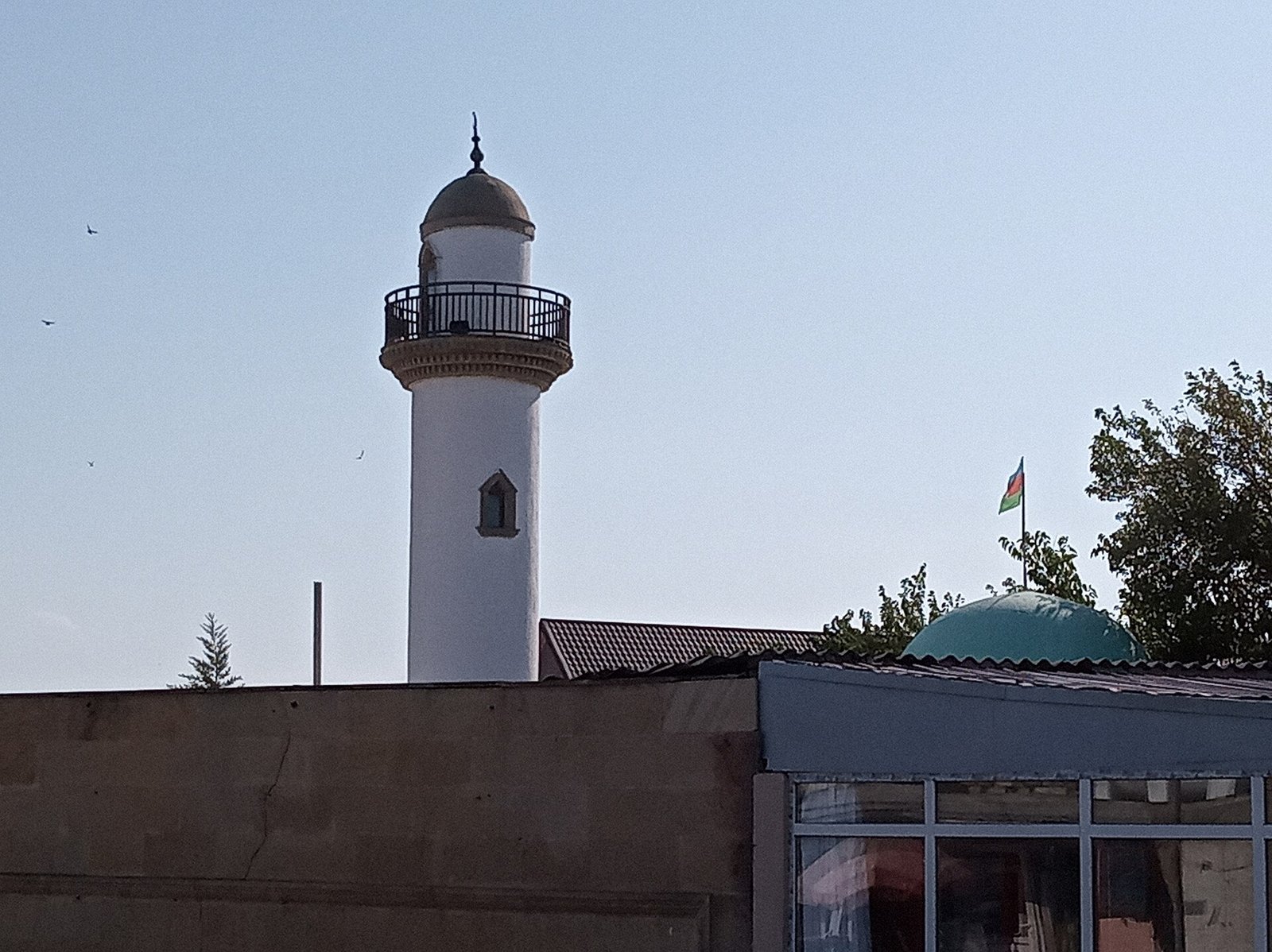
The settlement's main historic building is the Friday mosque at 73 Ajdar Malikov Street, also known as the Seyid Qadir mosque. Most sources date it to 1658 and name Seyid Qadir as its builder; some publications say “over 600 years old” or “16th century,” so the dating should be treated as disputed.
The building covers about 190 square metres and holds some sixty worshippers, with a separate two-tier section for women. Inscriptions on the walls are dated 1887 and 1908, and the one on the wooden minbar 1925. The 1908 repair was carried out by Pasha bey Safaraliyev.
In Soviet times the mosque was closed and used as a grain store; it reopened for prayer in the month of Muharram 1989. In 2008 the brothers Faig and Alakbar Taghizada funded a major restoration, when the minaret was added. The mosque is listed as a historical monument of local significance.
Two 19th-century stone bath-houses survive: the Haji Shahverdi bath — called “Qum hamami,” the sand bath, for its sandy surroundings — and the Haji Absalam bath. Both are built of local limestone and roofed with a pair of domes; round openings in the domes lit the steam room.
The Haji Shahverdi bath long stood in open sand without a fence. Its restoration was included in the reconstruction programme launched in 2021.
The settlement's name comes from a shrine, and there were several of them here. Older residents recall a large shrine called Shahi-pir at a fork of the caravan road; those making a wish tied strips of clothing to the branches of a black mulberry in its yard. After severe storms Shahi-pir, like the coastal dwellings, ended up buried.
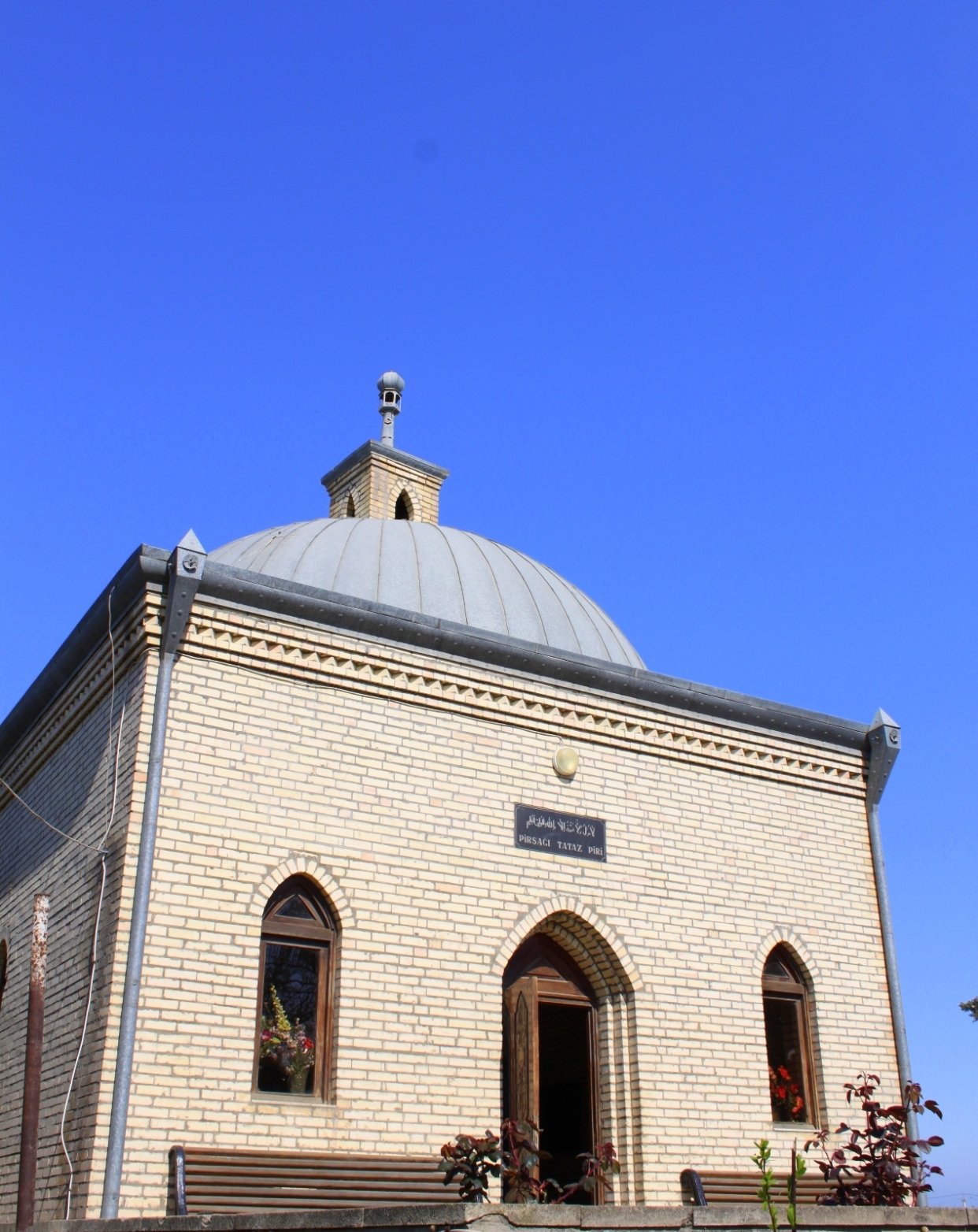
The shrine visited today is the restored Pirshagi Tataz pir; by tradition people came to it with skin ailments, and some still come seeking a cure. According to the Corpus of Epigraphic Monuments of Azerbaijan, only the foundation of the Piri-Shahi tomb survives, together with the gravestone of Sheikh Muhammad buried beside it; Piri-Shahi's own inscription has worn away, and a squeeze taken from it was kept in Professor Pakhomov's personal archive. The monument is dated to the 17th century.
Reconstruction since 2021
On 16 April 2021 the foundation was laid for large-scale reconstruction and restoration work in Pirshagi. The plan covers restoring the Haji Shahverdi bath, repairing the mosque and laying out a park in front of it on the traditional “chahar-bagh” pattern, with a pool and radiating paths. It is part of a programme of improvements in Baku's settlements running since 2019.