

Icherisheher
The old town inside Baku's fortress walls — its lanes, baths and caravanserais.
icherisheher.tut.az
Baku
From the fortress walls to the Flame Towers: places, transport, the fires of Absheron.
The old town inside Baku's fortress walls — its lanes, baths and caravanserais.
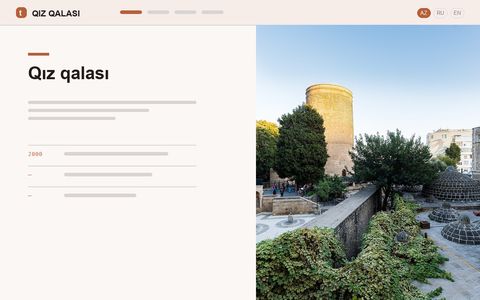
Baku's emblem: an eight-tier stone cylinder and the questions nobody has settled.
A 15th-century palace complex: divankhana, mosque, bathhouse and the rulers' tomb.
The seafront where Baku has been unwinding since 1909 — now a park tens of kilometres long.
Three towers whose facades turn into an LED screen at night — the postcard of modern Baku.
Zaha Hadid's building flows like a wave — a lesson in architecture without right angles.
An underground city running since 1967: mosaics, deep stations and everyday routes.
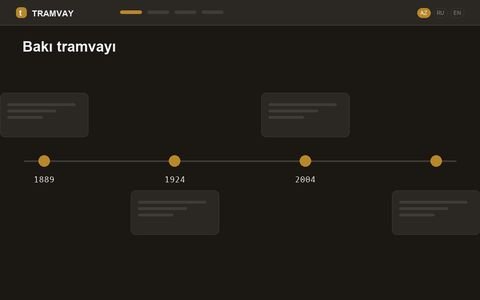
From the 1889 horse tram to the rails lifted in 2004 — the story of a network that vanished.
A short mountain railway from the boulevard up to the Alley of Martyrs — the city's simplest lift since 1960.
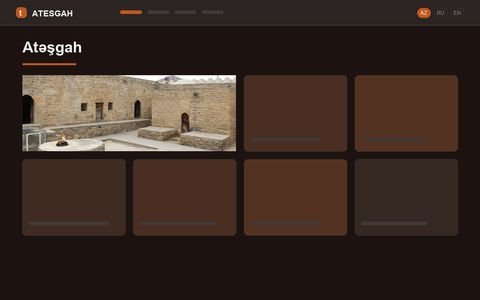
A pentagonal temple in Surakhani with a gas flame at its centre — the end of a pilgrims' road.
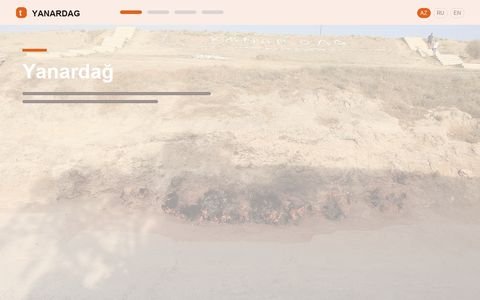
A hillside on the Absheron that has burned for decades — the plainest explanation of the “Land of Fire”.
A shrine demolished in 1936 and rebuilt at the end of the 1990s.
A Grand Prix on Baku's streets: six kilometres of track, a squeeze along the fortress wall and record speed.
A settlement on the Caspian shore: a sandy beach, a 17th-century mosque and the shrine behind its name.