
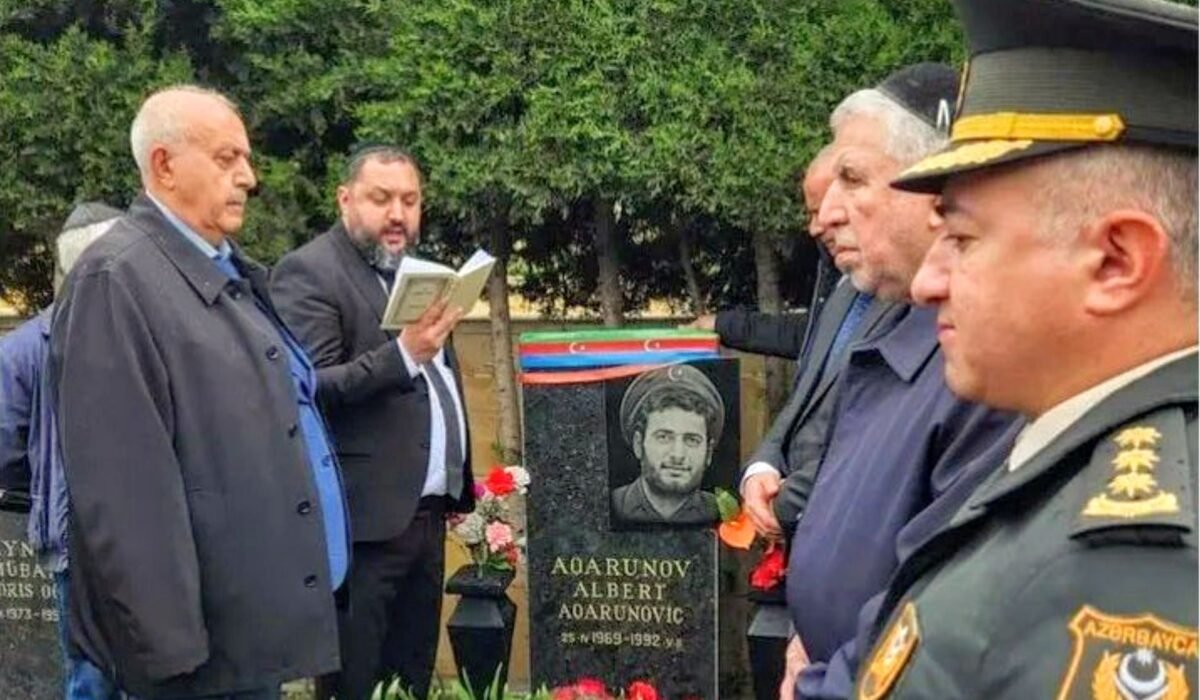
The campaign by Iran and information networks close to it, which in recent weeks has targeted relations between Azerbaijan and Israel, has entered a new phase. Materials published by Israel’s “Channel 7” and The Jerusalem Post state that this time the main target is Azerbaijan’s National Hero of Jewish origin, Albert Agarunov.
A campaign against the memory of Albert Agarunov has been launched on various Azerbaijani-language social media accounts. Posts circulating on Telegram, TikTok, X, and Facebook platforms seek to discredit his heroic legacy. Expressions such as “The lie about Albert Agarunov has collapsed” and “his story is a fabrication” are used in these posts.
The articles note that some of the posts were accompanied by hashtags and terms used by provocative groups supported by Iran in Azerbaijan and presenting themselves as an “opposition” to the country’s secular authorities. Although some of the accounts portray themselves as representatives of the opposition, the language and terminology they use overlap with the lexicon of pro-Iranian networks associated with the “Axis of Resistance.”
The timing, content, and wording of the posts align with broader pro-Iranian narratives in which Azerbaijan is targeted because of its relations with Israel. This campaign coincides with a period in which Iran and forces close to it have once again revived claims that Azerbaijan has become a platform for Israeli operations against Iran.
Born in Baku in 1969, Mountain Jew Albert Agarunov voluntarily joined the Azerbaijani Army during the First Karabakh War. Serving as a tank commander, A. Agarunov was killed on May 8, 1992, during the battles for Shusha. He was later awarded the title of National Hero of Azerbaijan, the country’s highest distinction.
He was buried in the Alley of Martyrs in Baku under the flags of Azerbaijan and Israel. A school was named after him, and a monument to him was erected in one of Baku’s districts.
It should be noted that The Jerusalem Post had previously published a special article commemorating A. Agarunov, emphasizing that he was not only a war hero but also a symbol of interfaith solidarity and a shared civic identity in Azerbaijan.
Israeli media note that A. Agarunov never concealed his Jewish identity and that his ethnic background remains an inseparable part of public memory in Azerbaijan. Posts about him that have circulated in recent days are regarded by Azerbaijani commentators and representatives of the Jewish community as part of a broader campaign aimed at tarnishing his reputation.
The campaign has triggered a backlash within Azerbaijani society. Numerous social media users continue to regard Albert Agarunov as a National Hero and have rejected the accusations directed against him. At the same time, Israel has long been viewed in Baku, particularly during and after the Karabakh wars, as an important security partner.
The articles state that this wave of information activity intensified further after CNN published a report on June 5 citing anonymous sources, claiming that Israeli military personnel, intelligence officers, and Mossad agents had been operating from southern Azerbaijan during the war with Iran. That report alleged that they were used for intelligence gathering, activities related to unmanned aerial vehicles, and possible rescue operations near Iran’s northern borders.
Azerbaijani officials firmly denied these reports. Baku stated that the territory of Azerbaijan is not permitted to be used for military operations, intelligence activities, or hostile actions against a third country.
The “Tasnim” and “Fars” agencies, which are linked to Iran’s Islamic Revolutionary Guard Corps (IRGC), have for many years claimed that Israel maintains military or intelligence infrastructure in Azerbaijan near Iran’s northern borders. Baku, however, has consistently rejected allegations concerning the deployment of foreign military bases and the use of Azerbaijani territory against Iran. Similar narratives also emerged in 2012, when both Azerbaijani and Israeli officials denied the reports being circulated.
A political source in Israel told Channel 7 that the attack on Albert Agarunov’s memory is part of a broader pattern of hybrid threats.
The Milli Majlis Committee on International Relations and Interparliamentary Ties had also previously stated that hundreds of Iran-linked accounts were carrying out coordinated disinformation activities. It emphasized that fake profiles operating on social media are directed against Azerbaijan’s independent policy, seek to spread the notion that “Baku serves Israel’s interests,” and aim to weaken public solidarity within the country.
Thus, according to the Israeli press, the latest campaign against the memory of Albert Agarunov is viewed not merely as an attack on one individual, but as part of a broader information war directed against Azerbaijan-Israel relations and social unity within the country.