
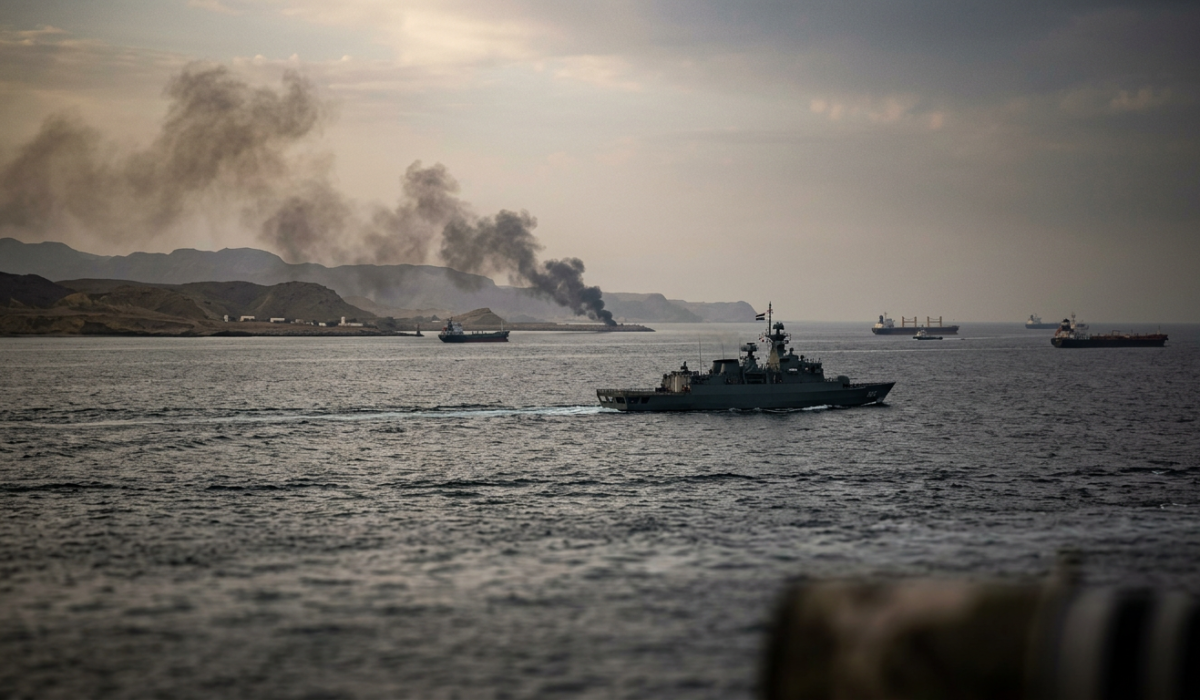
After several weeks of relative calm between the US and Iran, the military confrontation has entered a large-scale phase once again.
Jnews.az reports that the US Central Command (CENTCOM) announced that on September 1, it carried out new strikes against facilities belonging to the Islamic Revolutionary Guard Corps (IRGC) in Iran.
According to the US military, the attacks targeted air defense systems, radar installations, communication infrastructure, naval assets, and mining capabilities.
The US stated that the strikes were carried out in response to the threat Iran posed to American military personnel and commercial vessels in the Strait of Hormuz. US forces also targeted two state-owned Iranian oil tankers.
Iran launches retaliatory strikes on US facilities
Following the US attacks, Iran launched strikes against US military facilities located in the Middle East using missiles and unmanned aerial vehicles.
The primary targets of Iran’s attacks were US forces in Jordan and Iraq. Bahrain and other regional countries also released information regarding Iran’s attacks. Jordan stated that most of the missiles fired by Iran were intercepted.
Tehran, meanwhile, announced that the US strikes resulted in casualties among its forces and civilians. Condemning the US attacks, Tehran stated that retaliatory measures would continue. In addition, Iran demanded compliance with the terms of previously reached agreements.
Information reported on civilian casualties in Iran
Reports have emerged regarding civilian casualties resulting from a US strike on the Sirik region near the Strait of Hormuz in southern Iran.
During the strike, one of the houses near a wedding ceremony was struck. As a result of the incident, 5 people were reported killed and dozens injured. Some of the information relies on Iranian sources, and it has not been possible to independently verify all details.
Trump: Stronger strikes are possible
US President Donald Trump stated after Iran’s retaliatory attacks that Washington could resort to even harsher measures.
For its part, Iran demanded that the US halt its military operations in the region and warned that Washington’s continued attacks could further escalate the conflict.
Shipping in the Strait of Hormuz is under serious risk
One of the most significant consequences of the conflict is the increased threat to shipping in the Strait of Hormuz, one of the world’s main energy routes.
On September 1, two Saudi Arabian supertankers passing through the strait towards Oman were attacked by unidentified drones.
Following this, the number of commercial vessels passing through the Strait of Hormuz dropped sharply. According to Kpler data, only 4 cargo ships passed through the strait on September 1. This figure is significantly lower than the 10 ships recorded the previous day and the average of approximately 13 ships over the last ten days.
The Strait of Hormuz is of critical importance to the global energy market. A more severe impact of the conflict on maritime transport could lead to disruptions in oil supply and further price increases on the global market.
Oil prices rise, global markets under pressure
The renewed escalation of the US-Iran confrontation has also made itself felt in global energy and financial markets.
On September 2, the price of Brent crude oil exceeded $95. In the previous session, oil prices had risen by about 5 percent. Investors are mainly concerned about potential disruptions to oil shipments through the Strait of Hormuz.
Asian stock markets also recorded a significant decline. The MSCI Asia-Pacific index fell by approximately 2 percent, while South Korea’s KOSPI index dropped by about 4 percent. The yield on 10-year US Treasury bonds also rose to 4.81 percent, reaching one of the highest levels in recent years.