
Read the first part of the series here: https://jnews.az/en/the-jerusalem-question-history-religion-and-identity/
Read the second part of the series here: https://jnews.az/en/jerusalem-problem-history-religion-identity-part-2/
Read the third part of the series here: https://jnews.az/en/jerusalem-problem-history-religion-identity-part-ii/
Read the fourth part of the series here: https://jnews.az/en/jerusalem-problem-history-religion-identity-iv/
Immediately after Israel declared its independence, Egypt, Lebanon, Syria, Iraq, and Jordan launched a war against the newly created state. At that time, Israel had neither tanks nor sufficient heavy weaponry. Despite this, the Arab states were defeated at the end of the war.
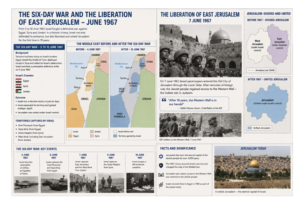
As a result of the war, Egypt, Jordan, and Syria took control of some territories intended by the UN for the future Arab state. Jerusalem was divided into two. The western part of the city remained under Israeli control, while the eastern part remained under Jordanian control. The defeated Arab states did not want to accept this defeat. Egypt closed the Straits of Tiran to Israeli shipping, and the Arab countries formed a new alliance against Israel.
In 1967, the Six-Day War took place. In this war, too, the Arab states were defeated. Israel captured the Sinai Peninsula, the Golan Heights, and the eastern part of Jerusalem. Thus, after many centuries, Jerusalem became a unified city again and, as it was in the time of David and Solomon, it turned into one of the main centers of Israel and the Jewish people.
However, conflicts in the region did not end there. In 1973, the Yom Kippur War occurred, and in 1982, the Lebanon War took place. In the subsequent period, Israel returned the Sinai Peninsula it had taken from Egypt.
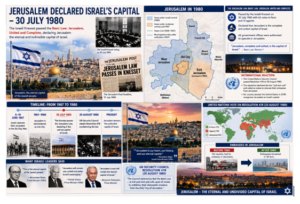
In 1980, the Israeli parliament declared Jerusalem the eternal capital of Israel. Today, Jerusalem is the capital of the State of Israel. The parliament, ministries, higher education institutions, and other important state institutions are located here. The city of David, for which struggles have been waged for millennia, has once again become the spiritual and political center of the Jewish people.
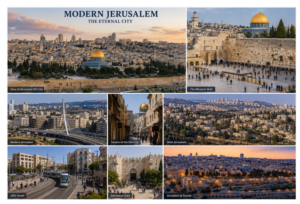
Modern Jerusalem
Today, Jerusalem is considered a holy city for all three monotheistic religions. Jews, Christians, and Muslims worship here. In the city, examples of modern architecture and ancient buildings complement each other, creating a unique harmony.
Jerusalem consists mainly of the Old City and modern city parts. The Old City is the area where ancient Jerusalem is located, and there are more than 220 historical monuments and religious sites here. Synagogues, churches, and mosques are located very close to each other. Members of the three religions use the same streets and roads to reach their places of worship.
The Old City consists of four quarters: Jewish, Christian, Muslim, and Armenian. Despite this division, representatives of different nations and religions living in the city have lived together here for many years.
Now let us look at Jerusalem through the prism of religions:
Jerusalem for Jews
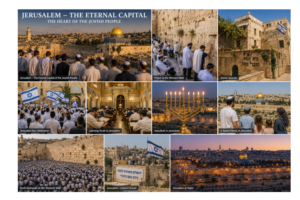
In history, no city has influenced the national consciousness of a nation as much as Jerusalem. The Jewish people have felt a deep spiritual connection to this city since the time of David. Regardless of where a Jew lives, they are connected to Jerusalem. Jerusalem holds a special place in their prayers, holidays, and days of mourning.
For Jews, the holiness of Jerusalem is linked to the location of God’s temple there and the formation of the Jewish people as a nation in this city. Even today, Jews pray in front of the Western Wall (Kotel), the remaining part of the destroyed temple, and pray to God for the rebuilding of the temple.
In the Torah, the Psalms, and other sacred texts, the name of Jerusalem is mentioned thousands of times.
In the Talmud, one of the main works of Jewish religious literature, it is said about Jerusalem: «There, those who captured us wanted songs from us, and those who oppressed us wanted joy. ‘Sing us one of the songs of Zion,’ they said to us. But we said: ‘How can we sing the Lord’s song in a foreign land? O Jerusalem, if I forget you, let my right hand wither. If I do not hold you above my greatest joy, let my tongue stick to the roof of my mouth!»
Such examples are numerous in sacred books. Every stone of Jerusalem is considered holy for Jews because they formed as a nation in these lands and built their state here. From the day they were expelled from Jerusalem, Jews have lived with a longing for this city, keeping it alive in their prayers and holidays. After Israel took control of the eastern part of Jerusalem in 1967, the Jewish longing for Jerusalem, which had lasted for nearly two thousand years, came to an end.
Jerusalem for Christians
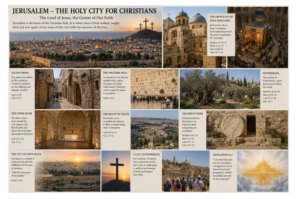
For a devout Christian, Jerusalem is the city chosen by God. This city, where Jesus lived and was crucified, has a special holiness in the Christian world. According to Christian belief, these lands have been sanctified by the blood of Jesus.
For centuries, visiting Golgotha Hill and praying in the Church of the Holy Sepulchre have been considered a great honor for Christians. For Christians, Jerusalem is the center of religious concepts related to both the beginning and the end of history. The belief in Jesus’ crucifixion and resurrection here has given the city special significance.
There are many holy sites in Jerusalem considered important for Christianity. The Church of the Holy Sepulchre, the Church of the Flagellation, the Church of Saint Anne, and the Russian Orthodox and Greek Orthodox churches are just a few of them. Even today, millions of Christians come to Jerusalem every year to visit the places where Jesus lived and operated.
Jerusalem for Muslims
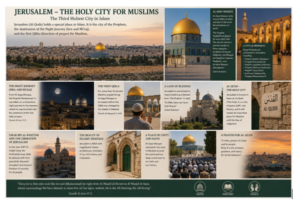
Jerusalem, the first qibla of Islam, is also a holy city for Muslims. It is considered the third holiest city in the Islamic world after Mecca and Medina.
The importance of Jerusalem for Muslims is linked to the Prophet Muhammad’s night journey (Isra and Mi’raj) and the fact that the city was the first qibla for Muslims. The first verse of Surah Al-Isra mentions the Prophet being taken from the Sacred Mosque to the Al-Aqsa Mosque.
There is an interesting point here. In the time of the Prophet, the Al-Aqsa Mosque building that exists today had not yet been built. This mosque, constructed during the Umayyad period, later became known by the name of that site. For this reason, some Islamic scholars accept that the holy site mentioned in the verse is related to the ancient temple complex located in that area. The expression Al-Aqsa Mosque means «the farthest mosque.»
The holiest sites in Jerusalem for Muslims are the Al-Aqsa Mosque and the Dome of the Rock. Although these two sites are sometimes confused with each other, they are different structures. Considered one of the oldest examples of Islamic architecture, the main religious significance of the Dome of the Rock is that it contains the Foundation Stone. According to Islamic tradition, Prophet Muhammad stepped on that rock before ascending to heaven.
For this reason, Jerusalem has been one of the holy cities visited and held in special reverence by Muslims for centuries.
Conclusion
As we can see, Jerusalem is a holy city for three monotheistic religions, and one of the main reasons for the disputes surrounding its status today is precisely this religious significance. Nevertheless, the city is historically closely linked to the Jewish people, and this connection has been formed since the time of King David.
In Christianity, the holiness of Jerusalem is associated with Jesus Christ living, operating, and dying here. In Islam, the holiness of the city is explained by Prophet Muhammad’s night journey and it being the first qibla. For Jews, Jerusalem is the main center where both their religious and national identity were formed.
Historical sequence shows that Moses brought the Children of Israel to these lands, King David made Jerusalem the capital of the state, and King Solomon built the Temple there. In subsequent periods, Jews fought for the city and, despite long years of exile, preserved Jerusalem in their religious memory.
Jerusalem also holds a special place in sacred texts. Jerusalem is mentioned 850 times in the Torah and 142 times in the Bible, while in the Quran, it is accepted that it is referred to only in the first verse of Surah Al-Isra. Historical sources confirm Jerusalem’s connection to King David, and this connection holds a central place in Jewish tradition.
Even after the arrival of Islam in the region, a Jewish community lived in Jerusalem.
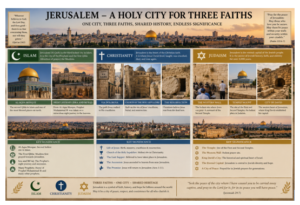
In the Holy Quran, it is said about the Children of Israel: «We settled the Children of Israel in a beautiful land and provided them with good things.» (Holy Quran, Yunus, 93)
In general, Jerusalem is a city where three religions intersect and which carries religious significance for each of them. Along with this, the role of the Jewish people in its historical formation is earlier and more fundamental. The city has been at the center of attention of various civilizations for centuries and maintains its importance today.
I end my article with a verse from the Holy Quran: «Thus, We made the Children of Israel heirs to those lands.» (Holy Quran, Ash-Shu’ara, 59)
Bibliography
Sacred sources
- Holy Quran (various translations and commentary editions)
- Torah (Tanakh) – Jewish sacred texts
- Bible (New and Old Testaments)
Historical and scientific literature
- Josephus, Flavius. The Jewish War
- Armstrong, Karen. Jerusalem: One City, Three Faiths
- Montefiore, Simon Sebag. Jerusalem: The Biography
- Gilbert, Martin. Jerusalem in the Twentieth Century
- Lewis, Bernard. The Middle East: A Brief History of the Last 2,000 Years
- Bright, John. A History of Israel
- Cleveland, William L. A History of the Modern Middle East
Encyclopedic sources
- Encyclopaedia Britannica – «Jerusalem» article
- Oxford Biblical Studies Online – History of Jerusalem and ancient Israel
- The Cambridge History of Judaism – Jewish history and religious development
Islamic history sources
- Ibn Kathir. Al-Bidayah wan-Nihayah
- At-Tabari. History of Prophets and Kings
Internet resources
- Encyclopaedia Britannica Online – https://www.britannica.com/place/Jerusalem
- UNISPAL (United Nations Information System on the Question of Palestine) – https://www.un.org/unispal
- Israel Ministry of Foreign Affairs – https://mfa.gov.il
- Palestinian Authority – https://www.palestine-studies.org
- Yale University Press. The Archaeology of Jerusalem. https://yalebooks.yale.edu/book/9780300216622/the-archaeology-of-jerusalem
- Encyclopedia.com – Jerusalem entry – https://www.encyclopedia.com
- Yale University Press. The Anchor Yale Bible Dictionary. https://yalebooks.yale.edu/book/9780300140033/the-anchor-yale-bible-dictionary-h-j
- Encyclopaedia Britannica. «Jerusalem.» https://www.britannica.com/place/Jerusalem
Murad Salmanov