
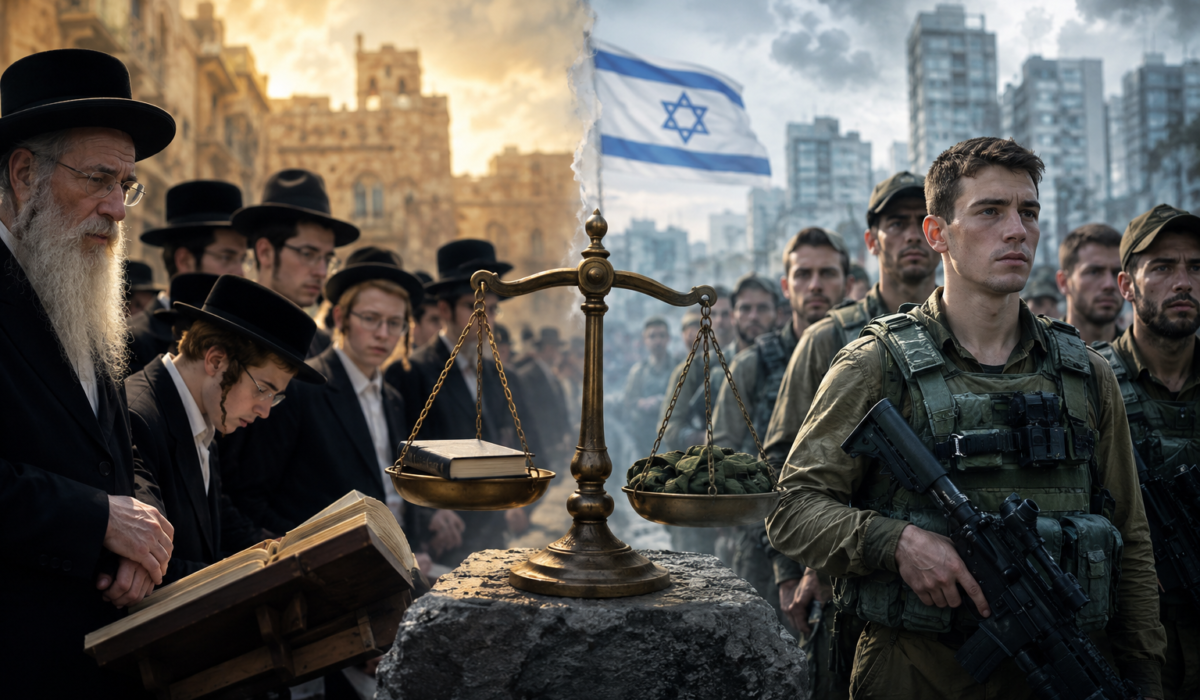
A rift in Israeli society: why has the issue of military service become existential?
In recent months, Israel has faced a sharp escalation of internal contradictions related to the conscription of ultra-Orthodox sector representatives into the IDF. Large-scale protests, accompanied by blocking of transport arteries and clashes, have highlighted a deep ideological conflict between the secular part of society and communities that prioritize Torah study in their existence.
Spiritual Foundation vs. Legal Realities
At the heart of the conflict lies a fundamental question of what exactly ensures the survival of the Jewish people. According to proponents of maintaining the deferment system for yeshiva students, Torah study is the "spiritual shield" of the nation. Historical arguments are cited that adherence to religious traditions allowed Jews to maintain their identity for two millennia of exile, despite the absence of statehood and their own army.
According to available data, the modern discussion began with a historical compromise reached during the formation of the state, when a quota for deferments was established for several hundred yeshiva students. However, demographic changes and the growth of the Orthodox sector have led to the issue of conscription now affecting about 15% of the annual contingent of conscripts. Legally, the situation worsened after the Supreme Court of Israel (BAGATZ) recognized previous legislative mechanisms regulating these deferments as untenable due to a violation of the principle of equality of citizens.
The Problem of Dialogue and State Structure
The editorial board of jnews.az notes that the crisis has ceased to be purely legal. Attempts to impose a solution to the problem exclusively by force or through coercion cause legitimate resistance. The current situation is characterized as a "state within a state," where two parts of society live within the framework of factually different coordinate systems: a secular democratic model and a model based on religious law.
Among the key problems requiring attention are the following:
- Lack of constitutional recognition: In Israel, the value of Torah study as a significant element of national security or cultural heritage is currently not enshrined within constitutional laws.
- Discrimination and social tension: Practical pressure measures, such as depriving families of yeshiva students of benefits (e.g., kindergarten subsidies), only intensify alienation.
- The issue of integration quality: There are proposals to create alternative service paths, but these are met with reluctance from religious communities to undergo "progressive" ideological processing within army structures.
Risks and Development Scenarios
An analysis of the current situation shows that a forceful solution to the conscription issue in the short term could lead to even greater division. Without developing a new "status quo" that would take into account the interests of both sides and be based on mutual recognition of the value of both military service and intellectual contribution to the preservation of Jewish identity, the conflict will only escalate. Attention should be focused on creating platforms for constructive dialogue and finding a formula that allows coexistence within a single state organism.
What This Means
- Threat to stability: Ongoing protests and societal polarization weaken the country's internal unity in the face of external threats.
- Political deadlock: No political leader in the current conditions is capable of quickly resolving the "generational problem" without risking a large-scale public crisis.
- Need for reforms: It will likely be necessary to develop new legislative initiatives that institutionally fix the balance between the need for conscription and the preservation of religious institutions.
- Economic aspect: The growth of a sector not integrated into the economy and the army poses new challenges for the state system of resource distribution and tax burden.