
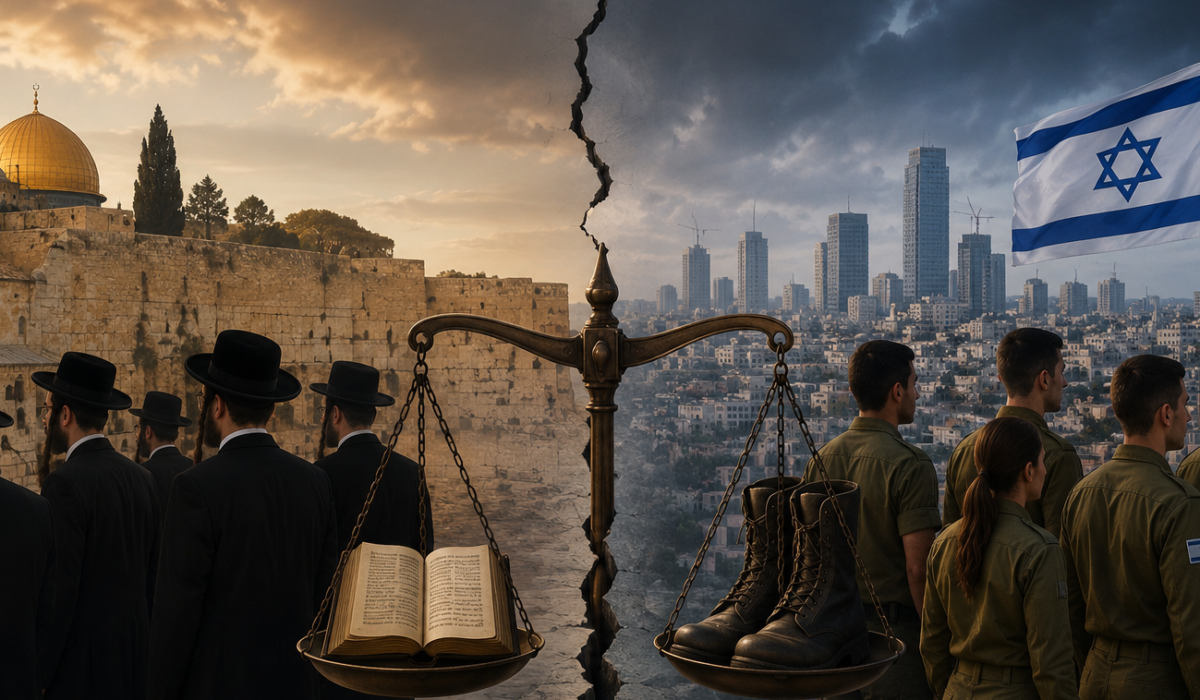
Discussions surrounding the integration of ultra-Orthodox Jews into military service remain one of the most acute social issues in Israel. This problem, with deep historical roots and a worldview character, demands not radical measures but the search for a new model of coexistence based on mutual respect and recognition of each segment of society's contribution to the country's future.
Spiritual Factor and Statehood
Throughout history, the Jewish people have largely preserved their identity for two millennia thanks to their devotion to the study of the Torah. In the modern context, a part of society continues to view this process as a fundamental spiritual mission that ensures the integrity of the nation. In this regard, the study of the Torah is not an evasion of duties, but rather plays the role of a "spiritual shield."
The notion that the State of Israel should rely solely on military power contradicts the traditional approach, which holds that the country's progress is impossible without preserving its spiritual foundation. In this context, society must find a balance where the defense of borders and the intellectual and religious contribution to preserving national identity are equally valued.
Legal Impasse and the "Status Quo"
Modern debates around the law concerning deferments for Yeshiva students are further inflamed by legal decisions that primarily attempt to apply uniform standards without considering the specifics of the religious way of life. Coercive measures, including the cancellation of concessions and legal restrictions, are reported by experts to only lead to increased social tension and mutual alienation.
According to available data, an effective solution to the problem lies not in coercion, but in restoring the status quo already achieved by the state's founding fathers. History proves that radical measures often backfire, while the search for compromise solutions allows for the integration of various population groups without harming their fundamental worldview principles.
Risks and Prospects
The main danger of the current situation is the further deepening of fragmentation within society. When parties do not listen to each other, dialogue is replaced by mutual accusations.
To prevent tension, the approach of viewing the army as the sole institution of socialization must be reconsidered. Alternative service models tailored to the demands of various population groups can alleviate some of the tension. However, this requires the political elite to be ready for long-term and flexible planning.
What Does This Mean?
Social disintegration: Continued confrontation poses a threat of deep fragmentation that weakens the state in the face of external threats.
Necessity of dialogue: Methods of compulsory service do not yield sustainable results; on the contrary, they further intensify confrontation.
Worldview conflict: The root of the dispute lies in differing understandings of values — between a secular, progressive model and a traditional religious concept.
Economic contribution: The Yeshiva environment is a vital social and economic center, whose activities, for example, are integrated into the urban infrastructure of Jerusalem.
Status quo as a solution: A return to a model based on mutual respect and recognition of various contributions to the country's security and welfare remains the most realistic solution.