History
Twenty centuries inside one oval of walls: a port, the seat of the Shirvanshahs, a khanate capital, a garrison town, a reserve.
How to read this timeline
The exact date of the city's founding is unknown: Baku has been studied only lightly by archaeologists. Finds — a jug from the 3rd–1st centuries BC in the palace courtyard, ceramics of the 4th–1st centuries BC, ancient column bases — allow us to speak of a town already in antiquity. By the 1st century AD Baku was a small port.
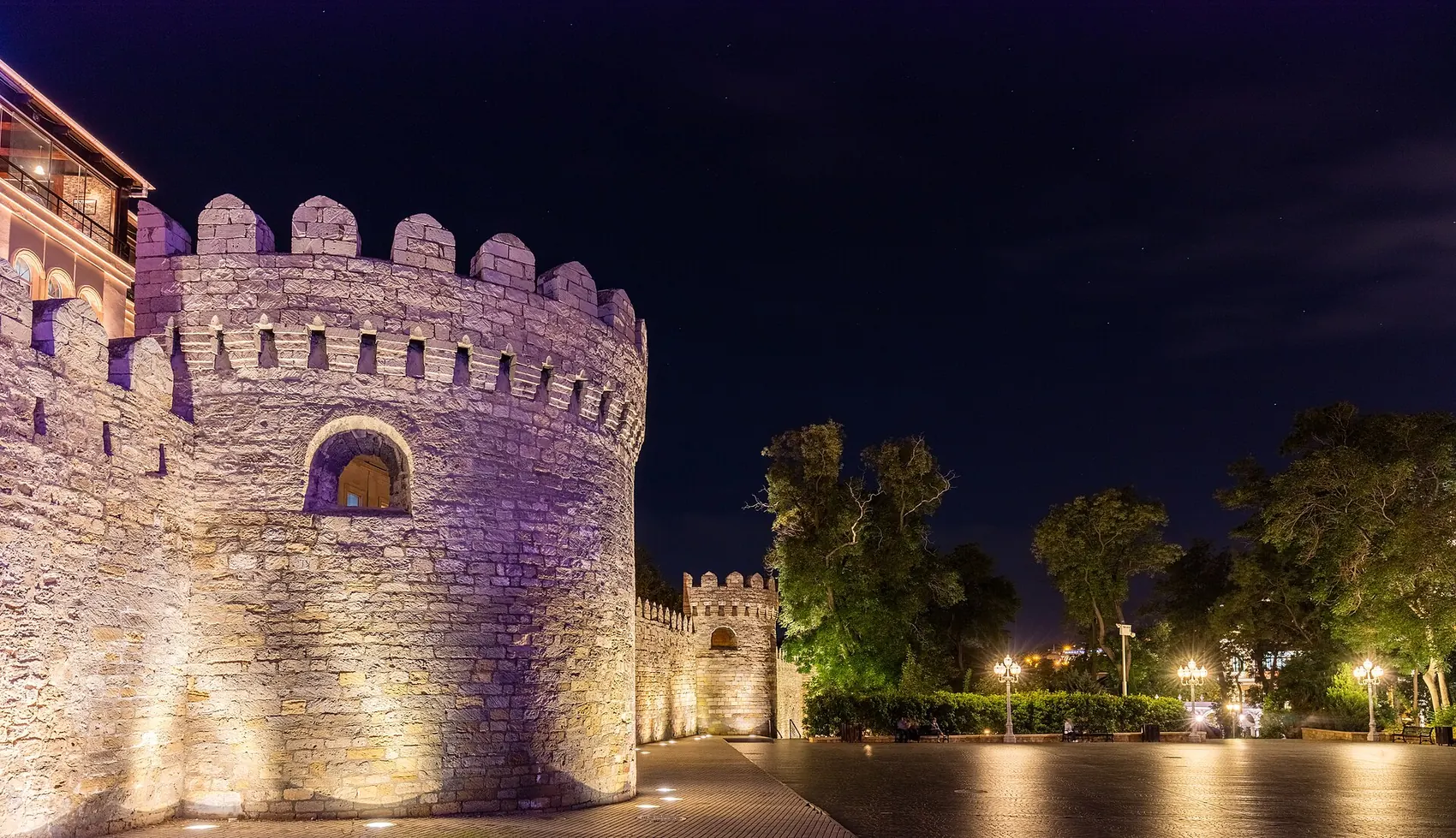
From there the history of İçərişəhər is the story of one fortress on a hill changing roles several times: a sea port, the capital of independent Shirvan, the centre of the Baku Khanate, a Russian garrison, and since 1977 a protected reserve.
By year
- A dense town
Excavations show developed crafts and trade; the medieval layer by the south-eastern façade of the future palace is dated to the 8th century.
- A raid of the Rus
According to al-Masudi the Rus reached the oil-bearing shore in the realm of the Shirvanshahs. Shirvanshah Ali ibn Haytham had no fleet and went out against them on barges and merchant ships.
- Walls against the Oghuz
The Shirvanshahs begin building fortifications around their towns, fearing an invasion by the Oghuz Turks.
- The Muhammad Mosque
The earliest dated monument in the fortress: the inscription says the mosque was ordered by “the master, the chief Muhammad, son of Abu Bakr”.
- The fortress and the Maiden Tower
The city walls are raised and fortification works carried out; the Maiden Tower is part of the defensive system. The poet Khaqani Shirvani praises Baku as an impregnable stronghold.
- The capital moves
After an earthquake destroys Shamakhi, Shirvanshah Akhsitan I moves his residence to Baku.
- Mongols at the walls
Abd ar-Rashid al-Bakuvi writes that the Mongols were long unable to take the heavily fortified stronghold by the sea: the city submitted only after the whole country had been conquered.
- The age of Khalilullah
Baku becomes the capital of the Shirvanshah state. Work begins on the palace ensemble, caravanserais and bridges.
- Murad's Gate
The only 16th-century monument in the palace complex: the inscription says it was built in 994 AH in honour of Sultan Murad III.
- The second wall
By order of Zulfiqar Khan an outer wall and gates are erected — they were known as the Zulfiqar Khan Gate.
- The “broken tower”
Russian troops under General Matyushkin shell the city; the minaret of the Muhammad Mosque is damaged — hence its name Sınıqqala, “the broken tower”.
- Capital of the khanate
Baku, concentrated inside the walls, is the capital of the Baku Khanate.
- A Russian garrison
The city has 500 houses, 707 shops and about seven thousand residents. In 1807–1811 the walls are repaired; the city has two main gates, the Salyan and the Shamakhi.
- The wall is sold
The section facing the sea is dismantled and the stone sold for 44,000 roubles. The money goes into laying out the boulevard.
- A new Juma Mosque
A new building in the neo-Persian style replaces the ancient Juma Mosque; the 15th-century minaret remains.
- The lighthouse leaves
The lighthouse on the Maiden Tower blends into the lights of the growing city and is moved to Böyük Zirə island.
- A reserve
İçərişəhər is declared a historical and architectural reserve.
- UNESCO
In December the Old City with the palace and the tower is inscribed on the World Heritage List — the first such site in Azerbaijan.
- On the danger list
After the earthquake of November 2000 and complaints about the quality of restoration the site is placed on the List of World Heritage in Danger; it is removed in 2009.
- Repairing the gates
Restoration and reinforcement of part of the twin gates and of sections of the walls are completed.
The Inner and the Outer City
When Baku spread beyond the walls a division appeared: İçəri Şəhər, “the inner city”, and Bayır Şəhər, “the outer”. The opera singer Huseyngulu Sarabski recalled that those living inside considered themselves the real Bakuvians and called the rest “the barefooted people of the outer city”.
The oil boom reversed the balance: the new Baku of mansions and oil fields grew around the fortress and left it a quiet quarter inside a large city.
Baku.ws news
The feed of the news portal
 EconomyAzerbaijani oil has become cheaper909080808010:09
 WorldThe number of drones shot down on approach to Moscow has risen to 103, three people injured10:00
 PoliticsDeputy: Statements by Russian officials directed at Azerbaijan entail legal liability23:57
 WorldTrump doubts Iran's readiness to sign a deal with the US23:56
Headlines and photographs come from baku.ws; the feed was updated on 18 August 2026. The links lead to the publisher's site.
Sources
Facts were checked against Wikipedia articles in four languages, the UNESCO World Heritage entry and the site of the Reserve administration. Where sources disagree, both versions are given.